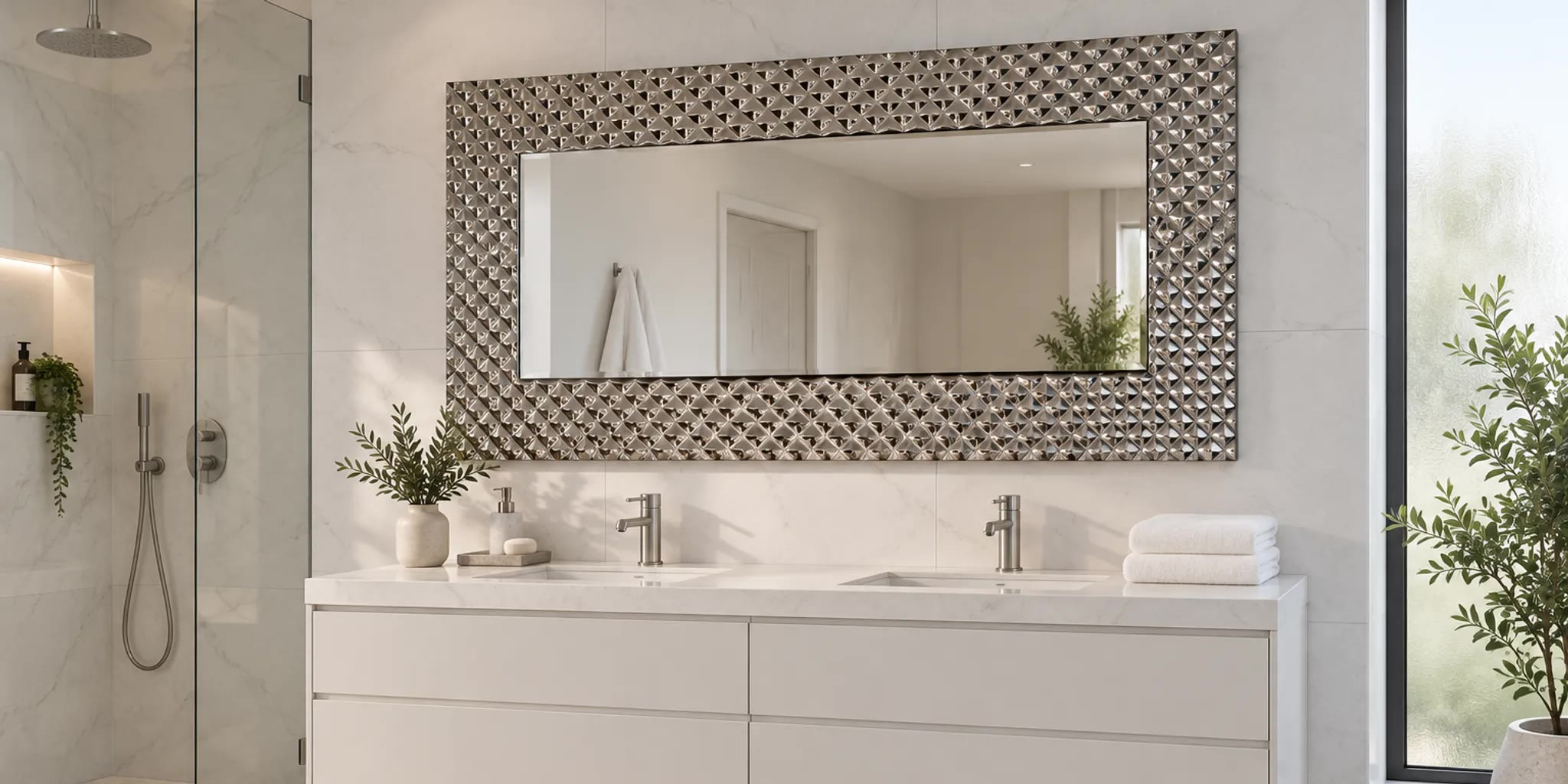
A European style bathroom mirror should do more than reflect the room. It can set the mood, balance the vanity, improve how the space feels in daily use, and connect contemporary details with a warmer, more personal interior. The best choice is not always the largest mirror or the most ornate frame. Start with the room’s proportions and routines, then select a shape, finish, and lighting relationship that feels intentional.
Schedule a design consultation to plan your bathroom details
“European style” is not one fixed look. A mirror might feel crisp and contemporary, sculptural and Italianate, or quietly traditional with a restrained frame. What connects these approaches is attention to proportion, material, craftsmanship, and the way each object works as part of the whole room. A mirror should relate to the vanity, faucet, lighting, tile, and surrounding architecture instead of competing with them.
That approach can work in a warm or traditional home just as naturally as in a newly built modern bathroom. A clean-lined mirror can make traditional millwork feel lighter. A thin metal frame can echo a classic faucet without turning the room into a period set. A soft arch can add character above a simple vanity while leaving the rest of the composition calm.
Think of the mirror as both a practical surface and a piece of visual furniture. Its outline creates a strong shape on the wall; its frame contributes color and texture; and its placement determines how the vanity reads from the doorway. A considered mirror can make familiar materials feel more cohesive, rather than requiring every finish in the room to match exactly.
Begin with the width and shape of the vanity, not with a mirror you happen to like in a photograph. A mirror that is too narrow can look disconnected from the sink area. One that extends far beyond the vanity may feel visually heavy or collide with nearby walls, lights, cabinets, or trim. Measure the available wall and note anything that affects the usable area before comparing styles.
For a single-sink vanity, a mirror somewhat narrower than the vanity often creates a clear margin at both sides. A mirror close to the vanity’s width can also work when the surrounding wall is open and the edges align neatly with the furniture below. For a double vanity, consider whether one broad mirror or two separate mirrors better supports the layout. Separate mirrors can give each sink a defined zone; a single mirror can make the wall read as one continuous plane.
Height matters as much as width. Check the distance between the countertop and ceiling, the position of sconces, and the height of anyone who will regularly use the mirror. A tall mirror can draw the eye upward and make a compact vanity wall feel more expansive. A lower, wider mirror may suit a long vanity and a room with lower ceilings. Avoid choosing a shape before confirming that it can be centered at a useful height.
These checks are especially helpful when choosing a custom-size mirror or coordinating a mirror with made-to-order furnishings. A few inches can change the visual balance, so treat measurements as part of the design rather than a last-minute ordering detail.
Shape changes the room’s character even when the mirror has no frame. Choose an outline that responds to the dominant lines already present. A room with a rectangular vanity, square tile, and crisp cabinetry may benefit from a rounded mirror that softens the geometry. A room with curved details or a sculptural faucet might feel more composed with a simple rectangle that gives those elements room to stand out.
| Mirror shape | Visual effect | Often works well when | Check before choosing |
|---|---|---|---|
| Rectangle | Structured, quiet, and easy to align | The vanity and room have strong horizontal or vertical lines | Keep its edges clear of sconces, cabinets, and trim |
| Round or oval | Softens hard edges and adds a focal point | The vanity wall feels angular or needs a lighter visual note | Confirm the curved edge does not reduce useful mirror area |
| Arched | Adds height and a gentle architectural gesture | You want a distinctive outline without a highly decorative frame | Check the arch against the ceiling, lights, and nearby curves |
| Two individual mirrors | Creates separate, balanced stations | A double vanity has two clearly defined sink areas | Measure spacing between mirrors and between each mirror and light |
| Wide, single mirror | Creates a continuous horizontal plane | The vanity is long and the wall can support one broad shape | Plan access to lighting and any wall-mounted storage |
The table is a starting point, not a rulebook. For example, an arched mirror can feel at home in a traditional bathroom when its frame is simple and its finish relates to the rest of the room. A round mirror can work in a very modern space if the surrounding details stay disciplined. The key is to repeat a shape or material thoughtfully, rather than adding curves and metallic accents without a plan.
A frame gives the mirror a visual boundary. A slim frame can sharpen the outline without drawing too much attention. A substantial frame can make the mirror read more like a standalone object, which may suit a simple vanity wall. A frameless mirror keeps the effect quiet and can be useful when tile, stone, or cabinetry already brings plenty of detail.
Choose the frame finish in relation to nearby materials, but do not assume every metal must match. A warm brass frame may sit comfortably with a brass faucet, warm stone, or wood cabinet. A dark metal edge can connect to black hardware or add definition to a pale wall. A polished finish will catch more light and feel more prominent; a softer or brushed finish tends to read with less shine. The right choice depends on the mood you want and how much contrast the room can carry.
Wood can bring welcome warmth, especially in a bathroom with stone, ceramic, or cool-toned surfaces. However, bathrooms are exposed to moisture and changing conditions. Confirm that a frame’s materials and finish are appropriate for the intended environment, and follow the manufacturer’s care guidance. Do not assume that a beautiful material is automatically suitable for every location or installation.
When choosing between two finishes, compare physical samples in the actual room if possible. A finish can look different beside daylight, warm bulbs, tile, and countertop material than it does on a screen. Put samples near one another and step back to view the whole composition. The goal is not perfect uniformity; it is a deliberate relationship among the elements.
Plan the mirror and lighting together. A mirror can be correctly sized yet feel awkward if the lights crowd its edges or cast unwanted shadows across the face. Wall sconces placed at the sides of a mirror can create a balanced frame, while a fixture above it may suit a narrower wall or an existing electrical layout. Each arrangement needs to be considered in context with the mirror’s height, width, and shape.
Before finalizing a layout, mark the mirror outline and the proposed fixture positions on the wall. Check whether the light fixtures will visually overlap the mirror, whether there is enough clearance for installation, and whether the light reaches the area where you need it. If you are changing wiring or adding fixtures, consult a qualified professional and follow applicable electrical and building requirements. Do not rely on the mirror alone to solve lighting problems.
Reflective surfaces can also affect the atmosphere. A mirror may bounce daylight or a view into the room, which can make the vanity wall feel more open. At the same time, consider what it reflects from the doorway and other parts of the bathroom. A carefully positioned mirror makes the space feel composed; a poorly placed one can emphasize clutter or an unfinished wall.
For broader bath-planning resources, the National Kitchen & Bath Association is a professional starting point. For a project involving new fixtures, wiring, or construction, coordinate the mirror decision with the relevant design and installation professionals.
European modern design does not require a cold, minimal room. Pairing a clean mirror shape with warm wood, tactile stone, soft-colored tile, or carefully chosen metal details can create a bathroom that feels both current and inviting. The contrast between a simple outline and richer surrounding materials often gives the room its character.
In a traditional home, look at the details that are already working: the scale of the molding, the warmth of the cabinetry, the color of the stone, and the character of the hardware. A restrained frame can bridge classic architecture and a more contemporary vanity. If the room already has decorative tile or detailed millwork, a quieter mirror may let those features remain the focus. If the room is plain, a shaped mirror can supply one distinctive note.
Personalization is often more effective than repeating a showroom look exactly. You might keep the mirror’s frame understated but choose an expressive shape, or use a simple rectangle and let the finish provide contrast. Consider how the room feels during ordinary routines as well as how it appears in a photograph. A useful mirror, comfortable lighting, and finishes that feel good to live with matter as much as the first impression.
When two choices both seem plausible, compare them against the same room facts instead of judging each in isolation. Imagine a long double vanity with limited wall space between the faucets and two side walls. One broad horizontal mirror may make the vanity feel unified, but it could leave little room for side lighting. Two smaller mirrors can define individual stations and allow lights between or beside them, yet they introduce more visual breaks. The better arrangement depends on the actual wall width, the location of the sinks, and the lighting plan, not simply on whether one arrangement is more fashionable.
Make a quick sketch or take a straight-on photograph of the vanity wall. Draw the mirror edges, faucet positions, sconces, and any cabinetry to scale. Then compare the options from the bathroom doorway as well as from the position where someone will stand to use the sink. A layout that looks balanced up close can feel crowded from the entrance, while a more generous mirror can appear oversized when viewed across a narrow room.
Also compare the experience of using each option. Consider whether two people may use the vanity at once, whether the mirror needs to reflect a particular view or source of daylight, and whether a frame might make cleaning or access more involved. These are practical questions, but they also shape the room’s atmosphere. A carefully chosen mirror should support the life of the household, not only repeat a style reference.
If the plans still feel close, simplify the surrounding composition. Keep one element, the mirror shape, a distinctive frame, or a strong light fixture, as the focal point, and let the other choices support it. This creates room for personality without making a small bathroom feel visually busy. A quiet mirror can be the right decision when tile or cabinetry carries the character; a shaped or framed design can contribute more when the rest of the wall is restrained.
With a single vanity, the mirror usually centers on the sink and faucet, but the room may have another feature, such as a window or tall cabinet, which shifts the visual center. Align the mirror with the basin and the actual viewing position rather than assuming that the center of the wall is the correct point. If the vanity is offset, a thoughtfully placed mirror can make the arrangement feel intentional instead of making the wall appear out of balance.
With a double vanity, first decide whether both sinks need equal mirror space and whether the lights can be placed symmetrically. Two mirrors can make each station feel personal and leave a gap for a central sconce or cabinet. One continuous mirror can better suit a simple, uninterrupted wall and may reflect more of the room. In either case, mark the sink centers and fixture positions together; do not choose mirror widths based only on the available wall edges.
For a compact bathroom, avoid treating a bigger reflection as the only route to a roomier feeling. A mirror that fits its wall cleanly, reflects a considered view, and leaves room for useful lighting may make the space feel more settled than an oversized sheet of glass. In a larger bath, a wider or more distinctive mirror can anchor the vanity, but it still needs enough visual breathing room around its outline.
Before placing an order, gather the practical details that affect fit and installation. Confirm the finished mirror dimensions, orientation, frame depth, mounting hardware, and whether the product can be hung in the intended direction. Check the product’s care instructions and suitability for a bathroom setting. If the mirror is made to order, verify the approved measurements, finish, and any customization details in writing before production begins.
Installation planning deserves particular attention for oversized or heavy mirrors. Ask the supplier or installer to clarify who will handle mounting and what preparation is required. If the wall is tiled or the mirror needs a special support, resolve that before the bathroom work is complete. Clear responsibility helps avoid rushed decisions once the room is ready for finishing.
EuroHome’s Design Center provides a place to discuss design needs and view furniture in person. You can also learn more about the company’s European furniture and design approach as you plan a cohesive room. For practical purchasing questions, review the frequently asked questions and the details on delivery services. For help with a specific project or product inquiry, use the contact page.
Plan your bathroom details with a EuroHome design consultation
It can be, but it does not have to be. A mirror close to the vanity’s width may create a connected, balanced composition, while a narrower mirror leaves visible margins that can feel lighter. Measure the wall and check the position of lights, cabinets, and trim before deciding.
They can be. The useful reflection area depends on the mirror’s size and where it is mounted, so compare the actual dimensions with your daily needs. A round mirror can soften a room full of straight lines, but it should still be large and high enough for the people who use it.
Matching is one option, not a requirement. Related finishes can make the room feel cohesive, while a carefully chosen contrast can add depth. Compare real samples in the bathroom’s lighting and consider how the frame relates to the cabinet, tile, and other metal details.
It can be, but European style is not defined by one frame type. Frameless mirrors keep attention on proportion and surrounding materials; framed mirrors can add warmth, definition, or a stronger decorative note. Choose the option that best supports the complete room.
The strongest European-style bathroom mirror choice brings proportion, shape, finish, and lighting into one considered composition. Measure first, compare options in the room, and make sure the mirror suits both the architecture and the routines of the people who will use it. With those decisions in place, the mirror can feel like an integral part of a welcoming bathroom rather than an afterthought.


